Rafting/Kayaking & Cultural Tour of the Thunder Dragon Country of Bhutan

Trip Facts

  • Duration: 17 Days
  • Challenge level : Fair
  • Max Altitude:3800m
  • Group size : People
  • Best TimeSpring / Autumn
  • Destination :Bhutan

About Rafting/Kayaking & Cultural Tour of the Thunder Dragon Country of Bhutan


Experience the amazing, magical Kingdom of Bhutan!

Bhutan, a Buddhist kingdom on the eastern edge of the Himalayas, is known for its monasteries, fortresses (dzongs), and dramatic landscapes ranging from subtropical plains to steep mountains and valleys. In the High Himalayas, peaks like 7,326 m/24,035 ft Jomolhari attract trekkers. Paro Taktsang monastery (Tiger’s Nest) clings to cliffs above the forested Paro Valley.

Why Bhutan?

Perched in the Himalayas between India and China, tiny Bhutan, with cliff-hanging monasteries, golden-roofed temples, and colourful prayer flags strung along trails and peaks, stands as the last Buddhist kingdom on earth.

Its careful tourism policy has slowly opened the country to the outside world without compromising its culture and traditions or degrading its pristine environment – two pillars of Gross National Happiness (GNH), the unique philosophy guiding Bhutan’s government.

This guide navigates Bhutan’s cultural landscape, highlighting local customs and quirks as you plan your journey to the country known locally as Druk Yul, the Land of the Thunder Dragon.

Did You Know Bhutan is the World’s First Carbon-Negative Country?

Bhutan gained global attention for this achievement. Being roughly the same size as Switzerland, with only 10% of its population, a key factor in sustaining it is a landmark constitutional mandate requiring the country to maintain at least 60% forest coverage. This is supported by the environmental conservation pillar of GNH. Plastic has also been banned since 1999, though enforcement is irregular. Nevertheless, do your part to keep the environment clean. Plenty of signage reminds visitors along the way: “Clean & beautiful Bhutan is a feast for the soul,” reads one placard en route to the Tiger’s Nest Monastery.

Mindful Travel


Our genuinely hospitable and compassionate people rarely refuse guests’ requests. It’s therefore useful to know our local customs so that, when we welcome you to our kingdom, you may tread lightly on our soil and sacred sites.

This itinerary is intended as a guide only. Local conditions and weather may necessitate changes to the program and can affect the availability of the views and panoramas described. Be aware that all times stated are approximate and may vary with individual or group fitness, weather, trekking route, river level, and road conditions.

Trip Highlights

  • Rafting & Kayaking on Paro, Thimphu, Pho Chhu, and Mo Chhu rivers
  • Visit the iconic Paro Taktsang (Tiger’s Nest Monastery)
  • Explore Thimphu: dzongs, temples, stupas, museums, and markets
  • Sightseeing at Punakha Dzong, one of Bhutan’s largest fortresses
  • Discover Phobjikha Valley and Gangteng Monastery, home of the Black-Necked Cranes
  • Wildlife spotting: snow leopards, red pandas, Takin, and more
  • Experience Bhutanese culture & cuisine, including traditional dance programs
  • Enjoy scenic Himalayan landscapes from subtropical plains to alpine valleys
  • Trekking & hiking in Jigme Dorji National Park

Itinerary

This itinerary is intended as a guide only. Local conditions and weather may necessitate variations to the program and can affect the availability of views and panoramas described.
Be aware that all time stated are approximate and may vary with individual and group fitness, weather, Trekking route, river level and road conditions.

Full-day exploration in Kathmandu, and get ready to fly to Paro, Bhutan, the next day. Overnight stay in Kathmandu.

Not Included: Lunch and dinner.

Extra Cost: Three nights’ hotel in Kathmandu with airport pickup and drop-off costs £100 per person.

Arrival at Paro by air and transfer to your hotel. Upon arrival at Paro Airport (PBH), after immigration formalities and baggage collection, you will be met by our Adventure Hub Nepal ground partner representative and driven to the hotel for check-in. In the evening, enjoy an exploratory walk around Paro’s main street and market area.

Depending on your arrival time, we may be able to explore Paro in the afternoon and do a quick city sightseeing tour. Overnight stay in Paro.

After breakfast, we drive to our put-in point at Drukgyel and paddle down to Paro City. The journey finishes at the town centre, and we stay overnight at a hotel in Paro.

After breakfast, we paddle from Paro city to the finish point, Damchu. This is a wonderful river section with grade 2 and 3 + plus rapids. After we get off the river, we then drive back to Paro for an overnight stay at a hotel in Paro. 

After breakfast, we load all our gear into the bus and truck and drive to Day 3’s river journey starting at Damchu. From here, we paddle down to the confluence of the Paro and Thimphu Rivers, finishing around lunchtime.

After quickly loading all paddling gear into the truck and bus, we drive to Thimphu, the capital city of Bhutan, with an en route stop at Chuzom, the confluence of the Thimphu and Paro Rivers.

Thimphu is the centre of government, religion, commerce, and a hub of tourism. The capital blends tradition and modernity. Places to visit include temples, dzongs, chortens, museums, handicraft stores, nunneries, parks, and more. Three different styles of stupas—Tibetan, Nepalese, and Bhutanese—adorn the confluence.

Upon arrival in Thimphu, check into the hotel. In the evening, enjoy an exploratory walk around Thimphu’s main street and market area. Overnight, we’ll stay in Thimphu.

After breakfast, we drive 30 minutes to Jigme Dorji National Park (JDNP) to hike to Chari Monastery for a couple of hours. We have lunch at the monastery and then hike back to town. After lunch, we’ll do sightseeing around Thimphu. Overnight, we’ll stay in Thimphu.

More about Jigme Dorji National Park (JDNP)

Nestled in northwestern Bhutan, JDNP is one of the country’s most spectacular natural treasures. Spanning over 4,300 square kilometres, it is not only one of Bhutan’s largest national parks but also a vital ecological haven for a diverse range of flora and fauna, some of which are rare and endangered.

JDNP is a haven for wildlife enthusiasts, offering rare opportunities to glimpse elusive species in their natural habitat. Among the most sought-after sightings are the clouded leopard, snow leopard, Indian leopard, Bengal tiger, and Bhutan’s national animal, the Takin.

The Takin, also called the cattle chamois or gnu goat, is a large species of ungulate in the subfamily Caprinae found in the Eastern Himalayas. It includes four subspecies: the Mishmi Takin, the golden Takin, the Tibetan Takin, and the Bhutan Takin.

The park’s rugged terrain and dense forests also shelter other fascinating creatures, including the black musk deer, black bear, red panda, and sambar. For those with a keen eye, the striking spotted linsang, a rare and elusive carnivore, might also be seen.

After breakfast, we paddle the top section of the Thimphu River. We’ll stop for lunch in the town centre, and soon after lunch, we continue paddling from Thimphu to the Paro River confluence, then drive back to Thimphu. Overnight, we’ll stay in Thimphu.

After breakfast, we load all our gear into the bus or truck and then paddle from Thimphu town down to the confluence of the Thimphu and Paro Rivers. Afterwards, we’ll drive to Punakha Valley and stay overnight in Punakha.

After breakfast, we paddle the Pho Chhu in the morning and have lunch at the monastery at the confluence of the Pho and Mo Chhu rivers. We then visit Punakha Dzong monastery. In the afternoon, explore Punakha township. Overnight, we’ll stay in Punakha.

Let’s learn more about Punakha Dzong.

Celebrated as one of Bhutan's oldest, largest, and most striking fortified monasteries, Punakha Dzong holds an important relic and was the site of many battles with the Tibetans. The Dzong occupies a sacred place in the hearts of all Bhutanese people.

Punakha Dzong is located at the confluence of the Po Chu and Mo Chu and is the winter residence of the “Je Khenpo” and the Central Monastic Bod. Hee travels there from Thimphu on the first day of the tenth lunar month and spends his time there.

Such a great history: Zhabdrung Ngawang Namgyel laid the foundation stone in 1637. The dzong was intended to look similar to Ralung Monastery in Tibet, where Zhabdrung had previously resided. Gyelse Tendzin Rabgye expanded Punakha Dzong in 1680 when he extended the Dukhang to accommodate the growing number of monks. The complex contains seventeen shrines and temples, and houses the Ranjung Kharsapani, a vertebrae of Tsangpa Gyare Yeshe Dorje, as well as the Machen of Zhabdrung Ngawang Namgyel.

On our trip, we will be paddling both the Po Chu River and the Mo Chhu River and will visit the monastery cave in between these two lovely rivers at the confluence.

After breakfast, we pack and load everything into our bus or truck, then paddle the Mo Chhu for a couple of hours. After lunch, we’ll drive to the spectacular Phobjikha Valley for a two-night stay.

Established by Gyalse Pema Thinley, the grandson of the famous saint Pema Lingpa, this monastery sits atop a hill at an altitude of 2,800 m/ 9,186 ft above sea level and offers stunning views of the beautiful Phobjikha Valley. In 1613, Pema Trinley established the monastery and became the first Gangtey Tulku.

The Black-Necked Crane Festival

Black-Necked cranes, the only alpine crane species in the world, travel from their summer breeding grounds on the Tibetan Plateau to the picturesque Phobjikha Valley. Upon arrival, they circle Gangteng Monastery three times, as if practising circumambulation, and repeat this action when they return to Tibet in early spring. The black-necked crane is considered a sacred bird in Bhutan, revered as a symbol of longevity. The Black-Necked Crane Festival is celebrated every mid-November and draws an increasing number of travellers to the valley each year.

Black craned centre

For the protection of the Black Crane, the endangered species, the kingdom has set up a Royal Society for the Protection of Nature (RSPN). RSPN in the valley looks after the protection of the cranes and spreads awareness amongst the locals on the same. At the centre, they have a spotting area with powerful telescopes to help you see the cranes roosting in the valley.  The entry fee for the Black Crane Centre is nominal (Nu 100), and the centre is open from 9 AM to 5 PM.

On our tenth day, we’ll explore Phobjikha village, visit the monastery, and hike for a couple of hours. Overnight, we’ll stay in Phobjikha.

After breakfast, we pack up and continue our adventure, returning to Bumthang. We paddle a section of the Dang Chu River and then drive to Trongsa. Overnight, we’ll stay in Trongsa.

About Bumthang

Bumthang is known as the spiritual heartland of Bhutan. It is one of the country’s most historic districts, home to many sacred sites and monasteries. In the 8th century, Guru Rinpoche cured a local king of a spirit-induced ailment, leading the king—and eventually the entire country—to embrace Buddhism. The Buddhist saint Pema Lingpa was born in Bumthang, and many other renowned Buddhist yogis lived and practised here. As a result, Bumthang is a repository of sacred artifacts and monasteries.

Central Bhutan’s Bumthang comprises four valleys: Choekhor, Tang, Chumey, and Ura. These picturesque valleys were carved by ancient glaciers and feature peaceful landscapes dotted with potato, rice, and buckwheat fields. The name “Bumthang” translates directly to “beautiful fields.”

Today we’ll explore Trongsa, and the plan is to paddle the Mangde Chhu. After we paddle the Madge, we then drive to Bumthang and stay overnight in Bumthang.

Today, we explore around Bumthang and discover what it has to offer, including paddling the Tang Chu as part of our plan.

After breakfast, plan on some paddling if time allows, and then drive back to Paro from Bumthang. Overnight, we’ll stay in Paro.

Taktsang Monastery, famously known as the Tiger’s Nest, is located in the Paro district of Bhutan. The monastery is one of the most venerated pilgrimage sites in the Himalayas. Taktsang clings to a rock towering 800 m (2,600 ft) above the valley and sits at 2,950 m (9,678 ft) above sea level.

The Tiger’s Nest Monastery (Taktsang Monastery) is a sacred Buddhist site near Paro. It was first built in 1692. Guru Rinpoche first meditated in the cave, marking a major event that introduced Buddhism to Bhutan.

Today begins with an early morning, possibly with a packed breakfast. We will visit Bhutan’s best-known secret place, the Tiger’s Nest Monastery, which clings to a cliff. After the hike, we return to the hotel for lunch and spend the afternoon relaxing. Enjoy some time for last-minute shopping, followed by a celebratory dinner in the evening. Overnight stay in Paro.

Today, we say goodbye to Bhutan and fly home, taking long-lasting memories of this wonderful country with us. (Or travel to Kathmandu to catch your flight home.)

Not Included: Lunch and dinner.

What's included

Included

  • All paddling gear, including kayak for kayakers
  • A minimum of 3 Star Government approved Accommodation in twin sharing basis.
  • All meals (Breakfast, Lunch, Dinner) with evening tea, coffee & snacks.
  • All transportation we have our own convoy of Imported Foreign vehicles - (Toyota SUV Cars for Fiat & Toyota H1, Hi-Ace Bus, and Coaster Bus for the group with driver) for all the internal transfers & sightseeing (excluding internal flights).
  • All Entrance Fees of museums and cultural sites.
  • A licensed English-speaking Bhutanese Tour Guide
  • 3 Star Hotel
  • All Local taxes and service charges.
  • Extra Services: Mineral water provided
  • All Entrance fees as per the program.
  • All Parking Fees
  • BUMTHANG TO PARO domestic flight included
  • Kathmandu to Paro Return flights included
  • One-time visa fees are included in your costing
  • Cultural Program as a surprise program (Bhutanese Dance)

What's Excluded

Excluded

  • Round-trip airfare/ train fare & Airport Taxes not included.
  • 4/5-star accommodation and meals
  • Travel Insurance
  • Luxury hotels & separate vehicles
  • Tips for Guide, Driver & other Staff
  • Trekking accessories like sleeping bags & shoes are not included.
  • Personal related expenses like calls, beverages, Alcohol, laundry, donations to Monasteries and Temples, Souvenirs, shopping, etc.
  • Tips for the support crew

TRIP CHECKLIST

  • Purchase travel insurance
  • Send a scanned copy of your passport and travel insurance to info@adventurehubnepal.com or ramkayak13@gmail.com
  • Make your flights and hotel reservations in anticipation of your arrival in Delhi (India)
  • Complete the AHN booking, health and waiver forms and sign then release them to Adventure Hub Nepal (AHN).
  • Final payment for the trip is due 90 days before your trip departure date

REQUIRED TRAVEL INSURANCE

You are required to purchase travel insurance that includes an evacuation benefit. Your trip insurance should cover the trip cost, Druk or Bhutan air flight, since there are no refunds once you have booked your flight. We strongly recommend travel insurance.

THE RENDEZVOUS MEETING PLACE TRIP             FLIGHT TIMES                            POST TRIP

Paro Airport                                                                   Will be announced                        Fly back to

Paro, Bhutan                                                                 2 weeks before the trip                 KTM or Delhi.

PASSPORT AND VISAS

Your passport must be valid for at least six months from your travel date. Digital copies of your Bhutan visa and Druk (Bhutan) airline ticket will be emailed to you two weeks before your trip. A paper copy of your ticket and visa is required to check in at the Delhi airport.

BEFORE YOUR TRIP, YOU HAVE OPTIONS.

The easiest way to fly to Bhutan is from Delhi on your Druk or Bhutan Airlines flight. You will arrive at Paro Airport, where everything, including your visa, will be arranged for you. We will meet you at the airport in Paro when your flight lands.

  1. Arrive in Delhi a day or two early to explore the city and recover from jet lag. This is highly recommended, as you’ll want to be well rested when you arrive in Bhutan.
  2. If you arrive in Delhi the day before your Paro flight, make sure to stay at a hotel near the airport.

FLYING FROM DELHI OR KTM TO PARO, BHUTAN.

At the Delhi airport, check in at the Druk or Bhutan Airlines counter. Please be aware that baggage over 30kg may be subject to an additional baggage fee. Please arrive at least two and a half hours early to check in. If you miss your flight to Bhutan, we may not be able to get you on another flight the same day.

WEATHER AND CLIMATE

The weather in July is typically pleasant, warm, and humid. Even though the weather is generally good, be prepared for cold and rain, as we travel between 4,000 and 11,000 ft, and temperatures can vary throughout the trip.

CLOTHING

The best clothes for Bhutan are practical and comfortable travel clothes. Most days, we will be meditating, walking through towns and national parks, and visiting cultural sites.

Ideal clothing consists of functional layers that look nice. Short sleeves are appropriate unless we are in a monastery, where long sleeves and long pants are required. Women can wear either pants or skirts that at least cover the knees for daily activities and full-length garments in monasteries.

PRO TIP

Bring a Ziplock bag with toilet paper in your daypack, as some public bathrooms don’t stock toilet paper.

WATER PURIFICATION

We will always have plenty of bottled purified water available, but the empty bottles add up, and it’s nice to purify your own water when possible.

ACCOMMODATION

Hotels vary in style and quality from town to town, but are generally considered one of the welcome surprises for visitors to Bhutan. During the colder months, hotels are heated, and extra blankets or comforters are provided in each room. Hotel staff are exceptionally accommodating and will do whatever they can to make guests feel comfortable. All hotels have their own restaurant, and some also have a bar.

BEING IN BHUTAN

The inhabitants of Bhutan are gracious, gentle, and very hospitable. They are peace-loving and possess a lively sense of humour. This is adventure travel, and travelling in a developing country consists of a fun, memorable and life-changing journey.

LOCAL CUSTOMS

There are many local customs, and Bhutanese are typically understanding when we don’t follow them. Even though they are understanding, we always do our best to be respectful.

CURRENCY OF BHUTAN

The national currency of Bhutan is the Ngultrum (NU), US dollars in crisp 100-dollar bills that can be exchanged when you arrive at the airport or in Thimphu. There are ATMs in Thimphu, but they are not reliable, so please do not depend on them. The nicer souvenir shops in Thimphu associated with hotels do take credit cards and can exchange dollars.

All normal expenses during the trip are covered except for drinks at our mealtime. Most people bring between $700 - $ 1200 USD cash for shopping, drinks and miscellaneous items and tips to guides, drivers, etc.

FOOD

Bhutanese typically eat a spicy dish called Ema Datsi, a zesty combination of peppers and cheese served with rice. We will typically eat western style food served buffet style at our hotels and restaurants. There will be a variety of meat and vegetable dishes with rice, noodles and tea, coffee, bottled water and soft drinks and beer will be available at an extra charge.

GRATUITIES

We are often asked if tipping is appropriate. Tips are certainly appreciated by your guides and are usually around 10% to 15% of the trip cost. Tips can be given to the trip leader, who will distribute them between all support crew on our trip.

SNACKS

Sharing makes the trip more social. We’ll provide ample snacks, but it’s always nice to bring something from home to share with the group. Feel free to share your favourite candy or mix bars with the rest of the group. Just be mindful that some people have allergies to nuts, so keep those to yourself.

Tourism Council of Bhutan states in its directive:

While tourism is an important source of revenue, Bhutan sees no gain in succumbing to over-commercialism. It recognises that a small country emerging from isolation must do so in its own time and at its own pace. The Tourism Council of Bhutan is clear that its policy of high value, low volume is the right approach, as Bhutan is simply too small for mass tourism. As the world begins to discover the Land of the Thunder Dragon, many visitors leave with a sense of having been in a special place, far from the insanity of modern life. Here is a land where life may not be materially luxurious, but it offers much that is good for a society not yet caught up in the global rat race.

VISA FORMALITIES

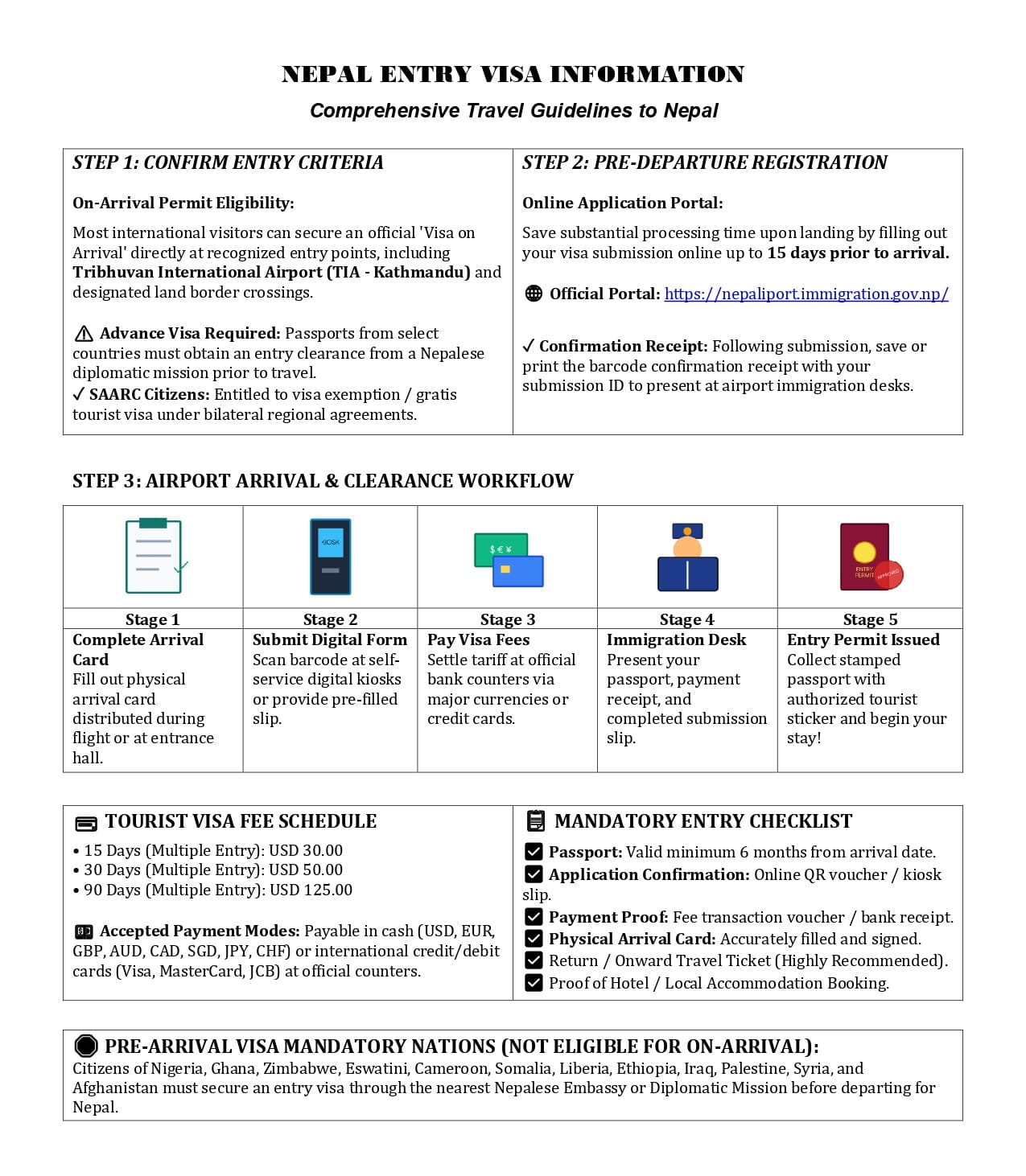
All visitors MUST obtain Visa clearance prior to travel to Bhutan; otherwise, you cannot enter Bhutan.

Visas are processed through an online system by Adventure Hub Nepal’s ground partner in Bhutan, either directly or through AHN.

You are required to send a copy of the photo page of your passport to AHN, which will then apply for your visa. The Tourism Council of Bhutan (TCB) will process the visa once full payment for your holiday—including the USD $40 visa fee—has been wired and received in the AHN’s bank account. Once received, visa clearance is typically processed within 72 working hours.

At your point of entry, you must show your visa clearance letter. Your visa will then be stamped into your passport upon arrival at Paro Airport in Bhutan.

Important Note:

  • A scanned copy of your original passport with clear details should be sent to us in advance.
  • Visitors must bring 3 copies of the latest colour Passport six photo for a visa.
  • For processing a Visa, we should receive your details at least three months in advance, because the time taken to process a Visa is almost 3 to 4 weeks.
  • All passengers are advised to check their passport validity, which should not be less than 6 months from the date of travel.
  • A Bhutan Visa will be issued and stamped in your passport only when you arrive at Paro airport in Bhutan.

Prior to your arrival in Bhutan, AHN will be asked to make the full payment (in terms of US Dollars) for the final trip balance of your trip.

GENERAL REMARKS:

  • The cost of air tickets is subject to change without prior notice by the airlines.
  • An extra supplement will be charged if the rooms are to be upgraded.
  • The complete tour payment must be made no later than 90 days prior to your trip in the US$ as per the wire payment instructions. This is to ensure that we secure visas, hotel reservations, transportation and guides.

HOW TO GET TO BHUTAN

Entering by Air: Paro is the only international airport in Bhutan. It is situated at a height of 2,250 m (7,382 ft) above sea level and is surrounded by mountains as high as 4,876 m (approximately 16,000 ft).

Domestic airports are located in Yonphula in eastern Bhutan, Bathing in central Bhutan, and Gelephu in south-central Bhutan.

Druk Air and Bhutan Airlines operate regularly to and from India (Delhi, Kolkata, Mumbai, Gaya, Guwahati, and Bagdogra), Thailand (Bangkok), Singapore (Changi), Bangladesh (Dhaka), and Nepal (Kathmandu).

Entering by Land (Road): Phuentsholing, Gelephu, and Samdrup Jongkhar are the only land border areas open to tourists. If you wish to travel overland, you can enter and exit Bhutan through its southern gateway, Phuentsholing, from the Indian state of West Bengal. It is approximately a six-hour drive from Thimphu. The nearest airport is at Bagdogra, about 170 km (106 mi) from Phuentsholing. This border point is an ideal junction for those wishing to combine their exploration of Bhutan with the Indian states of Sikkim and West Bengal (Darjeeling District).

Gelephu, in south-central Bhutan, is another entry point. It is approximately 250 km (155 mi) from Thimphu. The journey passes through Bhutan’s sub-tropical areas before entering the alpine zone and finally reaching Thimphu. Travellers will traverse three districts, and the travel time is about nine hours.

Samdrup Jongkhar, in south-east Bhutan, borders the Indian district of Darranga, Assam, and is approximately 150 km (93 mi) from Guwahati, the capital city of Assam. It is a three-hour drive from Samdrup Jongkhar to the Indian airport at Guwahati. Tourists entering Bhutan through Samdrup Jongkhar can continue to Trashigang and then travel over the lateral route to Mongar, Bumthang, Trongsa, Wangdue Phodrang, and finally Thimphu. The total distance is about 700 km (435 mi) and typically takes a minimum of three days. This route is usually preferred by those flying into Paro in the west and touring eastern Bhutan without backtracking.

Reservation & Cancellation Policy

We genuinely hope that you will successfully complete your Bhutan trip, creating the most enjoyable memories of Bhutan. We assure you that we will make every effort to ensure your experience in Bhutan is memorable. We do recognise that, at times, due to unavoidable circumstances, a trip to Bhutan may need to be cancelled or postponed. In such situations, AHN strongly recommends that you read through the AHN cancellation policy to protect both parties.